
How to Get an Order of Protection in New York (File Online or In Person)
In New York, you get an order of protection against a family member, partner or ex by filing a family offense petition in Family Court. You can file in person at your county’s Family Court, or send the petition online through EDDS, the New York courts’ Electronic Document Delivery System. Filing is free, and a judge can give you a temporary order of protection the same day you file or the next day the court is open.
LegalAtoms walks you through plain-language questions, fills in the official petition (Form 8-2) and sends it to your county’s Family Court through EDDS. If you’d rather file in person, you can download the forms instead.
Start your order of protection
If you are in danger now, call 911. For confidential help 24 hours a day, call the New York State Domestic and Sexual Violence Hotline at 1-800-942-6906 or text 844-997-2121. In New York City, you can also call 1-800-621-4673.
Which court gives orders of protection in New York
Three New York courts can issue an order of protection. Which one you use depends on who the other person is to you, and whether there’s a criminal case.
| Court | When it applies | How it starts |
|---|---|---|
| Family Court | The other person is a family member, a current or former spouse or partner, someone you have a child with, or someone you have an intimate relationship with | You file a family offense petition. This is a civil case that you start and control. |
| Criminal Court | The other person was arrested or charged with a crime against you. No family relationship is needed. | The district attorney asks the judge for the order in the criminal case. |
| Supreme Court | You and the other person are in a divorce case | You ask the judge in the divorce case for the order. |
You can go to Family Court and Criminal Court at the same time. This guide covers Family Court, because that’s the order you can ask for yourself and file online.
Who can file in Family Court
Under Family Court Act § 812, you can file a family offense petition against someone who is or was:
- Your spouse or former spouse
- Related to you by blood or by marriage
- The other parent of your child, even if you never married or lived together
- In an intimate relationship with you. It doesn’t have to be sexual, and you don’t have to have lived together. The judge looks at what kind of relationship it was, how often you saw each other and how long it lasted, so a casual friend, a co-worker or a roommate you were never close to doesn’t count.
If the person isn’t in one of these groups, Family Court can’t help. Report what happened to the police instead, because a criminal case can lead to an order of protection from Criminal Court.
What counts as a family offense
Your petition has to describe at least one act that New York law calls a family offense:
- Assault or attempted assault, and strangulation
- Harassment and aggravated harassment, including threatening calls, texts and messages
- Menacing, stalking and reckless endangerment
- Disorderly conduct
- Sexual abuse, sexual misconduct and forcible touching
- Coercion
- Criminal mischief (damaging your property)
- Identity theft and grand larceny
- Sharing intimate images of you without your consent
For each incident, write down the date, what the person did or said, where it happened and who saw it. The judge only knows what you write and tell them, so be specific. See what proof you need for an order of protection in New York.
The forms
You file one form. The judge writes the orders.
- Form 8-2 Family Offense Petition. This is the form you file. It names you, the other person and your relationship, then describes what happened and the protection you want.
- GF-21 Address confidentiality affirmation (optional). Use it if the other person learning your address would put you in danger.
- GF-5 Temporary order of protection, and GF-5a final order of protection. The judge issues these, so you don’t fill them in.
- GF-10 and GF-10a Motion and affirmation to extend or change an order, if you need to later.
- GF-8 Violation petition, if the person breaks the order.
The official forms are on the New York courts’ family offense forms page.
How to get an order of protection, step by step
1. Fill in the family offense petition
Write down each incident, most recent and most serious first. Then say what you need: for example, that the person stays away from your home, work and children, stops contacting you, or moves out of a home you share. The order can cover your children too, and can set temporary custody and child support.
2. File the petition with Family Court
File in the Family Court of the county where you live, where the other person lives, or where the incidents happened. You have two ways to file:
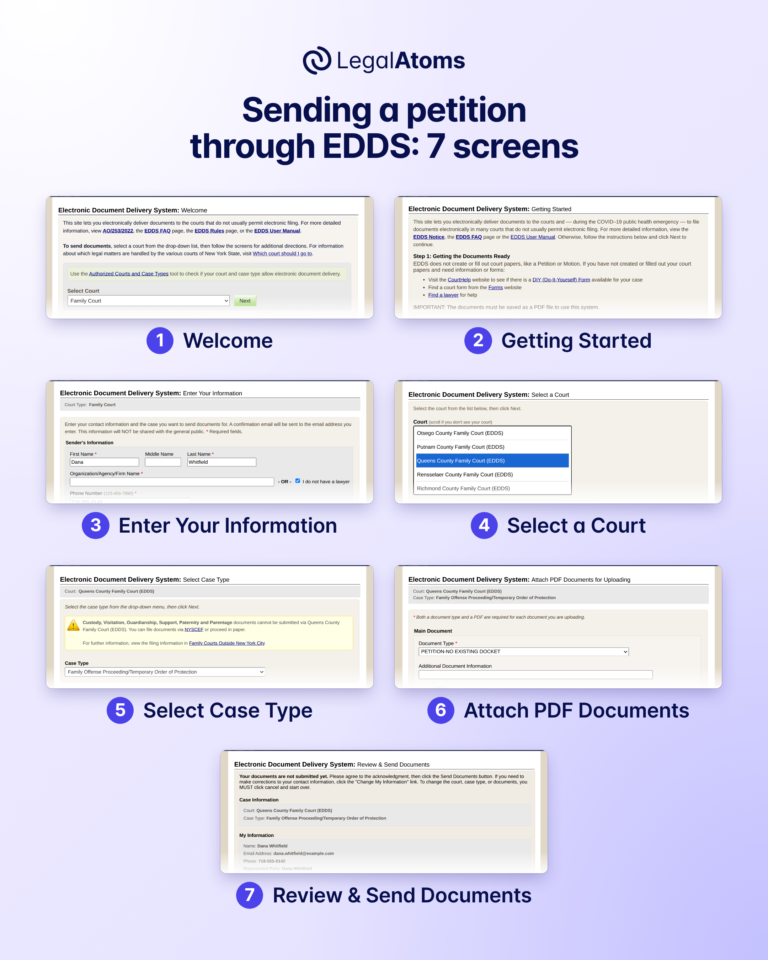
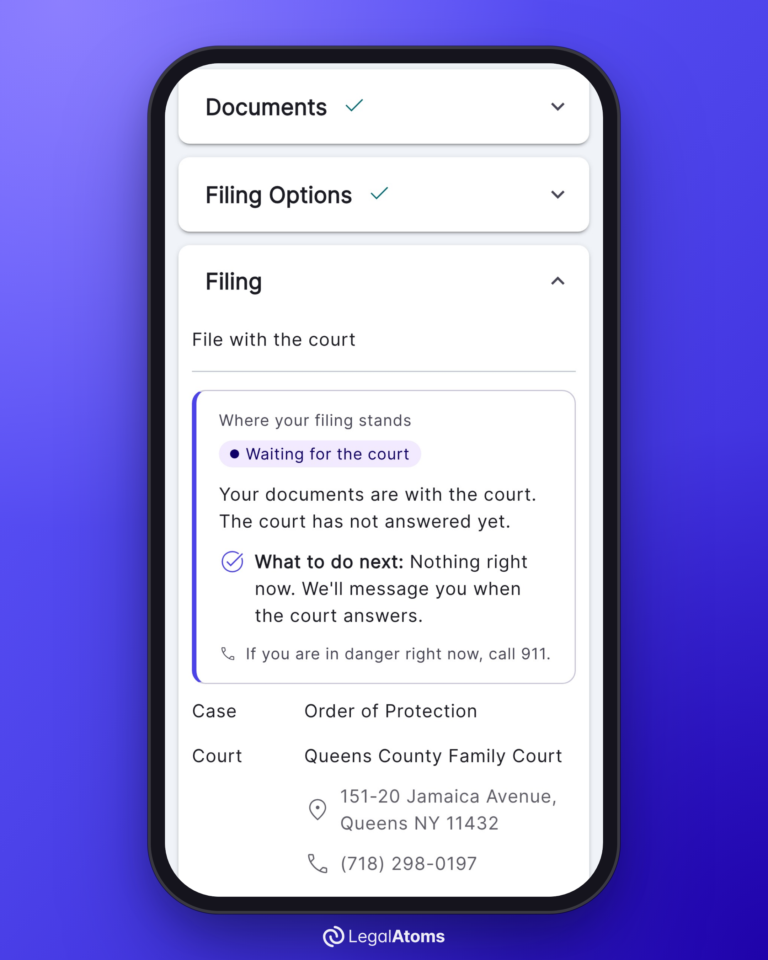
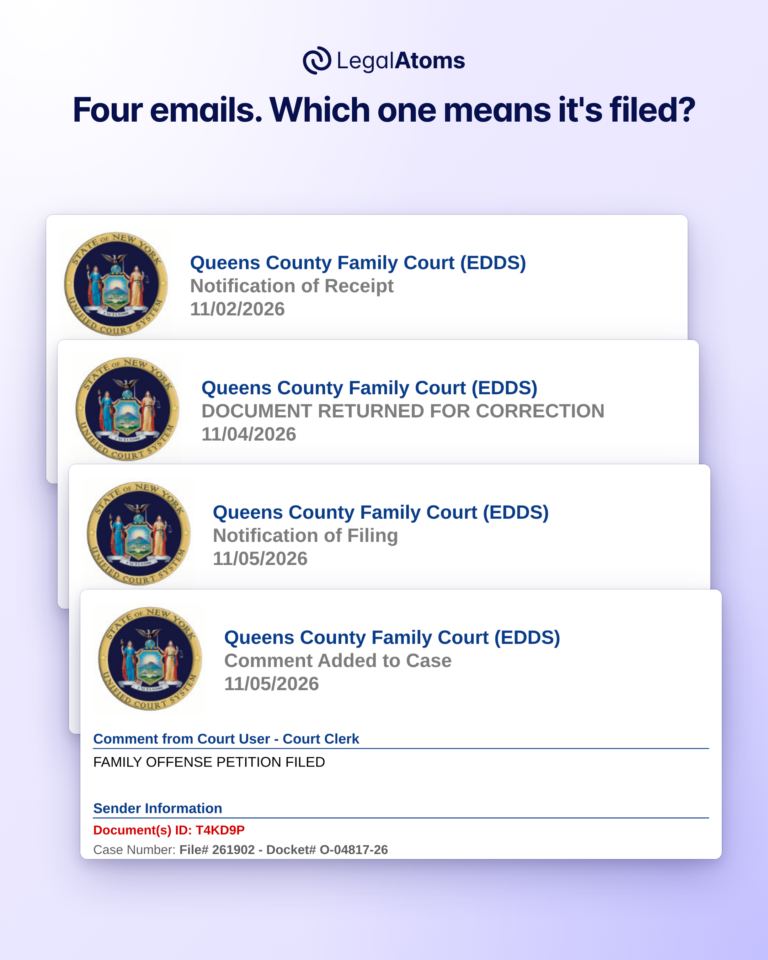
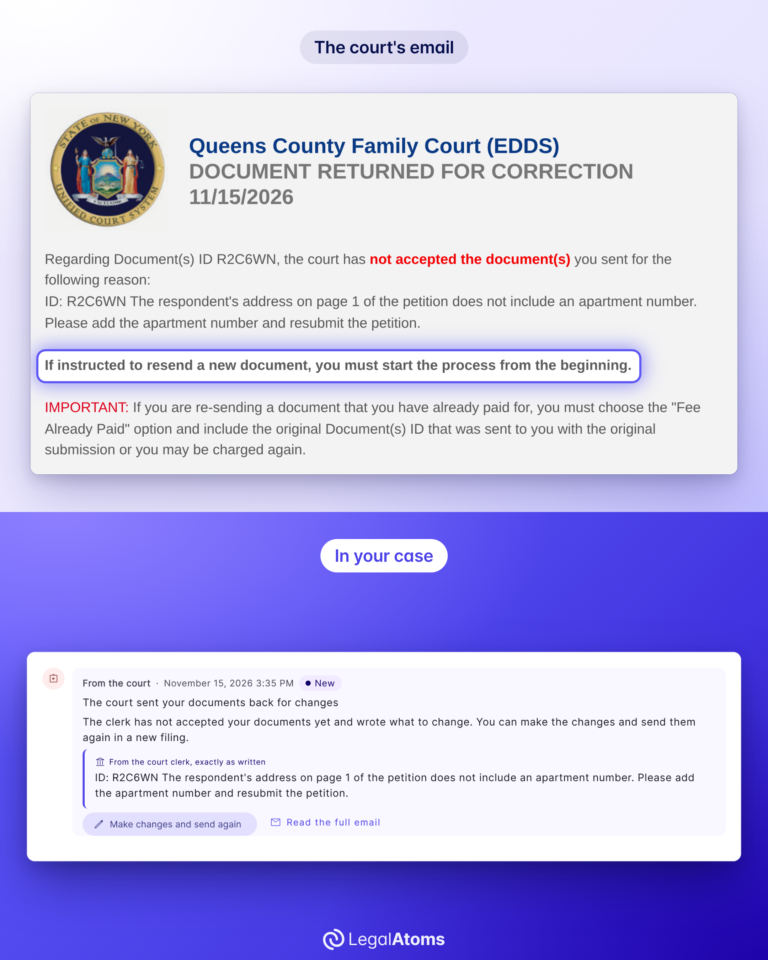
- Online through EDDS. You can send a family offense petition through EDDS without a lawyer. Sending it isn’t filing yet: your case is filed once the clerk accepts it, and then the court tells you when and how you’ll see the judge. A few courts also ask you to come in after you send it. LegalAtoms prepares the petition and sends it through EDDS for you. If you send it yourself, see every EDDS screen, step by step, what each court email means and what to do if the clerk returns it.
- In person. Go to the Family Court’s petition room on a weekday, early if you want to see a judge that day. In New York City the petition room opens at 8:30 a.m., and a clerk can help you fill in the petition.
If Family Court is closed (nights, weekends and holidays), ask a local criminal court for a temporary order instead. It lasts at most four days, so take your case to Family Court as soon as it opens. In New York City, go to the Criminal Court in your borough. Staten Island residents go to the Criminal Court in Brooklyn.
3. See a judge for a temporary order
The judge reviews your petition the same day you file or the next day the court is open. The other person isn’t there. If the judge finds good cause, you leave with a temporary order of protection. It lasts until the next court date, and the judge usually extends it at each date until the case ends. Go to every court date, because if you miss one, the temporary order can end and the case can be dismissed.
4. Serve the other person
The other person has to be handed the petition, the summons and the temporary order. The order can’t be enforced until that happens. You can’t serve the papers yourself. Any adult over 18 who isn’t part of the case can, and the police or the sheriff will do it for free. In New York City, the police make up to six attempts.
5. Go to the hearing
You both come back to court. The other person can agree to the order, or the judge holds a hearing where each of you gives evidence. If they were served and don’t show up, the judge can issue the order anyway. Read what happens at an order of protection hearing in New York.
6. Get the final order
If the judge finds that a family offense happened, you get a final order of protection. Keep a copy with you. If the person breaks it, call 911: breaking an order is a crime, the police have to arrest in many cases, and the person can go to jail. The order is valid in every state.
Full and limited orders
The judge can issue a full order, which tells the other person to stay away from you and not contact you at all, or a limited order (also called a “refrain from” order), which lets contact continue but orders them not to harass, threaten or hurt you. Limited orders are common when you live together or share children and want contact to continue. Ask for the kind you need in your petition.
How long an order of protection lasts
- Temporary order: until the next court date. The judge usually extends it at each date until the case ends.
- Final order: up to 2 years. Up to 5 years if the judge finds aggravating circumstances, such as a physical injury or use of a weapon, or that the person broke an earlier order of protection (Family Court Act § 842).
- Extending an order: ask the court before it expires (GF-10 and GF-10a), and explain why you still need protection.
What it costs
Filing in Family Court is free, and so is having the police or the sheriff serve the order. Both sides have the right to a lawyer, and if you can’t afford one, ask the judge to assign one for free.
Family Courts in New York City and nearby counties
Family Courts are open Monday to Friday, and in New York City the petition room opens at 8:30 a.m. Hours and holiday closures vary, so call before you go. Every county in New York has a Family Court; find yours on the New York courts website.
| County | Family Court address | Phone |
|---|---|---|
| Bronx | 900 Sheridan Avenue, Bronx, NY 10451 | 718-618-2098 |
| Brooklyn (Kings) | 330 Jay Street, Brooklyn, NY 11201 | 347-401-9610 |
| Manhattan (New York) | 60 Lafayette Street, New York, NY 10013 | 646-386-5223 |
| Queens | 151-20 Jamaica Avenue, Jamaica, NY 11432 | 718-298-0197 |
| Staten Island (Richmond) | 18 Richmond Terrace, Staten Island, NY 10301 | 718-675-8800 |
| Nassau | 101 County Seat Drive, Mineola, NY 11501 (the Westbury courthouse closed in May 2025) | See the court’s page |
| Suffolk | 400 Carleton Avenue, Central Islip, NY 11722, and 210 Center Drive, 2nd Floor, Riverhead, NY 11901 | 631-740-3800 (Central Islip), 631-852-3905 (Riverhead) |
| Westchester | 111 Dr. Martin Luther King Jr. Boulevard, White Plains; 26 Garden Street, 3rd Floor, New Rochelle; 131 Warburton Avenue, 3rd Floor, Yonkers | 914-824-5500 (White Plains), 914-831-6590 (New Rochelle), 914-831-6555 (Yonkers) |
| Monroe | 99 Exchange Boulevard, Room 360, Rochester, NY 14614 | 585-371-3544 |
More about orders of protection in New York
- How to send a family offense petition through EDDS
- Is my EDDS petition filed yet?
- The emails Family Court sends after EDDS
- Document returned for correction in EDDS
- What proof you need for an order of protection
- What happens at the hearing
- How long an order of protection lasts
- What happens if someone violates an order of protection
- How much a restraining order costs
- Protective order law in New York
Sources: NYC Family Court, Domestic Violence (Family Offense); Filing a Family Offense Petition; NYS Office for the Prevention of Domestic Violence, Orders of Protection; Family Court Act, Article 8.
Forms needed
These are the court forms typically required for this process. LegalAtoms prepares each of them for you automatically.
- UCS-FC8-2 Family Offense Petition
- OSC Statement Sheet
- TOP Temporary Order of Protection Sheet
- FC-INT Family Court Intake
- FODT Family Offense Data Sheet
- DVPS DV Pedigree Sheet
Keep reading
 NEW YORK
How to Send a Family Offense Petition Through EDDS, Screen by Screen
EDDS, the New York courts’ Electronic Document Delivery System, lets you send a family offense petition…
 NEW YORK
Is My EDDS Petition Filed Yet? Sent, Received and Filed in New York
Not until a clerk accepts it and tells you. EDDS, the New York courts’ Electronic Document…
 NEW YORK
The Emails New York Family Court Sends After EDDS, and What Each One Means
After you send an order of protection petition through EDDS, New York Family Court answers by…
 NEW YORK
Document Returned for Correction in EDDS: What It Means and What to Do
An email from New York Family Court titled “DOCUMENT RETURNED FOR CORRECTION” means a clerk read…